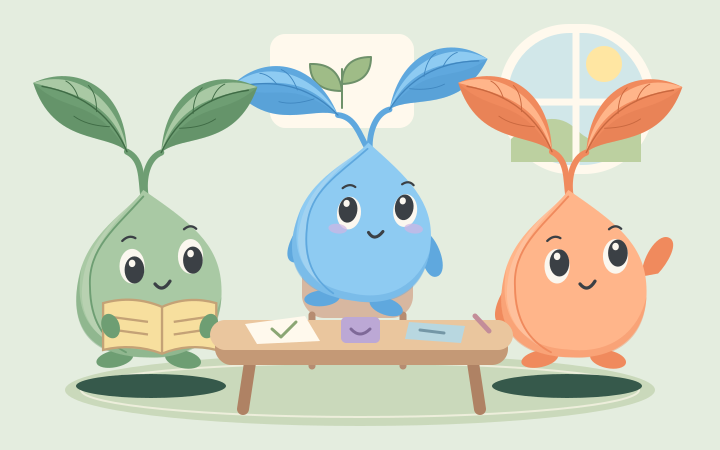
Bloomly is being designed with help from therapists who work with autistic children and children with learning disabilities. Their input is part of our design process as we build a playful space for feelings, everyday routines, and communication. Bloomly is a learning app, not individualized therapy.
Thoughtful input, a playful world
Choosing a learning app can raise a lot of questions. Who is it being built for? What does it ask a child to do? Is there room for a different way of communicating or a day when a little less feels better? At Bloomly, we want families to understand the thinking behind the characters and activities, as well as enjoy the world itself.
Therapists who work with autistic children and children with learning disabilities are helping inform Bloomly’s design. Their experience brings another perspective to a project centered on children who learn differently. We want that thoughtful foundation to sit comfortably alongside the warmth, curiosity, and imagination of Bloomly’s world.
What does “designed with therapist input” mean?
It means therapists contribute to the design conversation. It does not mean that the app provides a personal assessment, that every activity has a clinical endorsement, or that a particular outcome is guaranteed. Professional input and evidence about a finished product are different things.
Bloomly is still in development. Our promise here is about the people helping shape the experience, not a claim that using the app will produce a certain amount of progress. As we share more about Bloomly, we want our descriptions to stay as concrete and understandable as the activities themselves.
The everyday moments Bloomly is being built around
Our focus is small moments of practice: noticing a character’s feelings, exploring the steps of a familiar routine, or finding a way to ask for help. Pip, Peach, and Sky give those moments a playful setting. A story or game can be a starting point for something a family chooses to explore together.
For example, the planned Feelings Detective activity invites curiosity about feelings. Routine activities explore everyday sequences, while communication practice makes room for expressing needs. A grown-up can use these moments to start a conversation, follow a child’s interests, or simply enjoy a little shared play.
Different children, different ways to take part
Bloomly is being built for children ages 4–12 who learn differently. We do not expect one setting, pace, or way of responding to fit everyone. Our design includes adjustable sound, music, motion, and colors, along with choices about goals and session length.
Words, symbols, and gestures all have a place in Bloomly’s approach. Asking for help, setting a boundary, and taking a break are part of the experience we want to make room for. The aim is to offer opportunities to participate, with space for a child’s preferences and a grown-up’s support.
Where families fit in
Therapist input does not replace what a family knows about their child. Interests, comfortable settings, familiar communication tools, and everyday rhythms still matter when deciding whether an activity feels like a good fit. Bloomly is intended to sit alongside that knowledge.
When early access becomes available, a family might begin with one short shared activity and notice what the child enjoys or wants to change. There is no requirement to complete a collection or turn every moment into a lesson. A useful starting question is simply, “Would you like to try this together?”
A clear next step, without a commitment
Bloomly is in development for iPhone and iPad. The early-access waitlist is a way to hear when there is more to explore and decide whether it fits your family. It does not start a subscription or require payment.
If you are looking for a playful learning app with therapist input in its design, we would love to keep you in the loop. We will continue to describe what Bloomly offers clearly, while leaving room for families to make their own decisions.
Questions families ask
Is Bloomly designed with therapists?
Yes. Bloomly is designed with input from therapists who work with autistic children and children with learning disabilities. Their input is part of the design process while the app is in development.
Does therapist input make Bloomly a therapy app?
No. Bloomly is a learning and skills-practice app. It does not provide individualized assessment, diagnosis, or treatment, and it does not replace professional support.
Is every activity clinically validated?
We are not making that claim. Therapist input describes a contribution to design, not clinical validation of each activity or proof of outcomes.
How can my family try Bloomly?
Join the early-access waitlist for updates. Bloomly is being built for iPhone and iPad, and a release date has not been announced.
General educational information from Bloomly. For individualized guidance, talk with a qualified professional who knows your child.
A little something is growing.
Thoughtful input. Playful possibilities. Join the Bloomly waitlist to hear when your family can explore what is growing.
Join the waitlist In development for iPhone and iPad. No payment or commitment.